InsightTrust & SafetyNima

Building Fair and Scalable Trust & Safety Enforcement Systems

Over the past decade, T&S has cemented its position as a core business enabler and a must-have for all online platforms. This is evermore true in today's rapid and constantly changing online environment. New threat vectors - from coordinated scams and harassment to GenAI-enabled abuse - are emerging alongside an exponential increase in content volumes, often outpacing platforms’ ability to scale legacy moderation systems. At the same time, platforms must operate in an increasingly complex regulatory and political landscape internationally.

By Tremau T&S Research Team

  • 01/19/2026

Why Fair and Scalable Enforcement Matters

Taken together, these pressures are pushing Trust & Safety teams to reconsider their operational set-up and find ways to reconcile speed, scale, and fairness. T&S teams are no longer judged solely on whether harmful content is removed quickly, but also on how & why decisions are made. In other words, whether these can be explained, defended, and trusted – introducing a notion of fair and due process.

At scale, balancing speed, fairness and explainability creates a structural tension at the heart of all modern Trust & Safety operations:

  • Operational effectiveness, depends on fast, scalable systems designed to minimise decision time during moderation review;
  • Fair and explainable enforcement, meanwhile, depends on the consistent application of policies across billions of decisions, supported by explicit rationales.

As platforms scale, this tension intensifies. They are expected to demonstrate proportionate and consistent enforcement – even as content volumes continue to grow faster than human moderation capacity. Automation therefore becomes unavoidable, policies grow more complex to account for language and cultural differences, and enforcement decisions are increasingly scrutinised. When enforcement decisions are difficult to understand or appear unevenly applied – often due to siloded tools & processes – this may cause users to question platform fairness or infer censorship. Over time, these issues erode user trust and undermine a platform’s credibility.

To reconcile these competing demands, platforms need a principled Trust & Safety operating model built on clear policies, efficient reporting and appeals, sound moderation practices and  controlled automation, all underpinned by a well-designed orchestration layer built for scale. This model is regulation-agnostic: regardless of political pressure or changing legal requirement, robust Trust & Safety operations ground enforcement in consistent, transparent, and defensible decision-making.

The Foundation: Content and Account Policies

Effective enforcement begins with clear, explainable, operable policies. Without them, consistency breaks down internally, and users struggle to understand why enforcement actions occur.

Content and account policies define acceptable user content and behaviour, and corresponding consequences for breaking the rules. To function at scale, these policies must balance clarity with precision. Overly vague policies invite inconsistent interpretation; overly broad ones create enforcement gaps.

At a global level, this challenge is compounded by differing regulatory regimes a platform may operate within. Platforms are also increasingly under pressure to reconcile in a single policy framework divergent regional expectations and norms around areas such as speech, privacy, and harm. As a result, enforcement outcomes can appear even more opaque to users, particularly when users encounter content restrictions shaped by laws they do not recognise or understand.

For example, stating that a platform prohibits harassment is straightforward. Ensuring consistent enforcement requires translating that principle into concrete guidance: what language, behaviours, or contexts make content violative? This work is time-consuming, but foundational.

As platforms increasingly host multimodal content – text, images, video, audio, live streams – policies must evolve accordingly. A rule that works for text does not automatically translate to audio or live interactions (for example, if a platform has strong policies against the sexualisation of minors, how would this translate when enforced against an audio track?). Tiered enforcement models, with graduated penalties based on severity, help convert policy into predictable and proportionate outcomes while preserving discretion in edge cases.

Streamlining Intake: Efficient and Accurate Report Handling and Actioning

Policies only matter if reported harms are reviewed and actioned quickly. Tight operational Service Level Agreements (SLAs) reinforce user trust and position users as active contributors to platform safety.

At scale, prioritisation becomes essential. The most severe risks must be handled first, and moderator attention deployed where it adds the most value. Hybrid systems – combining automation and human review – enable this by routing high-risk cases to specialised teams while handling lower-risk violations through lighter-touch workflows.

Robust intake systems blend user reports with automated triage, smart queueing, and time-based prioritisation for time-sensitive cases. Incorporating quality signals, such as reporter reliability or age, historical enforcement data, or predicted harm severity, reduces noise and improves focus of moderation team, ensuring they concentrate on where the expertise is the most impactful.

Needless to say, user notifications and the ability to appeal decisions provide an essential feedback loop that should be built from the get-go, rather than retrofitted. Appeal rates become a critical quality signal once platforms scale, and delaying this infrastructure often creates downstream trust issues.

Centralised tooling further enables efficiency: configurable queues, contextual account signals, and automated deduplication allow reviewers to act faster and more accurately. These capabilities are especially important on platforms exposed to coordinated mass-reporting, such as gaming or social communities.

Finally, account-level strike systems address harmful behaviour over time. Well-designed strike frameworks deter repeat offenders without over-penalising users for isolated mistakes. TikTok’s 2023 shift to a strike-based system highlighted that repeat offenders follow predictable patterns – concentrated in specific features and policy categories – underscoring that repeat harm is rarely random. Well designed escalating penalties, strike expiry, and action across linked accounts are therefore essential for proportionate enforcement that help reduce harm exposure for other users.

Automation and AI as the Engine of Scale

At the scale of modern platforms, automation and AI are not optional – they are structural requirements. Content volume and threat velocity have surpassed what human-only systems can manage. In a single day in November 2023, seven very large platforms issued over 2.000.000 moderation decisions in the EU alone, the majority via automated systems.

Given these volumes, relying on user reporting alone is no longer sufficient. Moreover, user reports are often noisy. EA’s player safety data shows fewer than 1% of reports result in confirmed violations following their review highlighting just how many non-actionable reports platforms must filter through. Research on League of Legends similarly shows reporting is often driven by frustration rather than misconduct.

As a result, pro-active detection and automation enable Trust & Safety teams to scale without linear headcount growth. AI-driven detection, prioritisation, and enforcement reduce manual workload and accelerate response times. Early-stage platforms may rely on rules-based systems for the most egregious harms, while more mature platforms deploy machine learning across broader abuse categories. New technology, such as AI agents, also enable platforms to push automation further, ensuring human moderators concentrate on the most urgent or complex cases.

However, automation introduces quality risks and, without  the correct governance and continuous monitoring could lead to biases, under or over-enforcement – especially in context-heavy areas. These risks are magnified in non-English languages, as most models are predominantly trained on English data. Even multilingual systems often fail to capture cultural nuance.

Machine translation can help, but it rarely preserves contextual meaning. For example, associating the English word “dove” with peace may lead a model to misinterpret the Basque word uso, which can carry a derogatory, homophobic meaning.

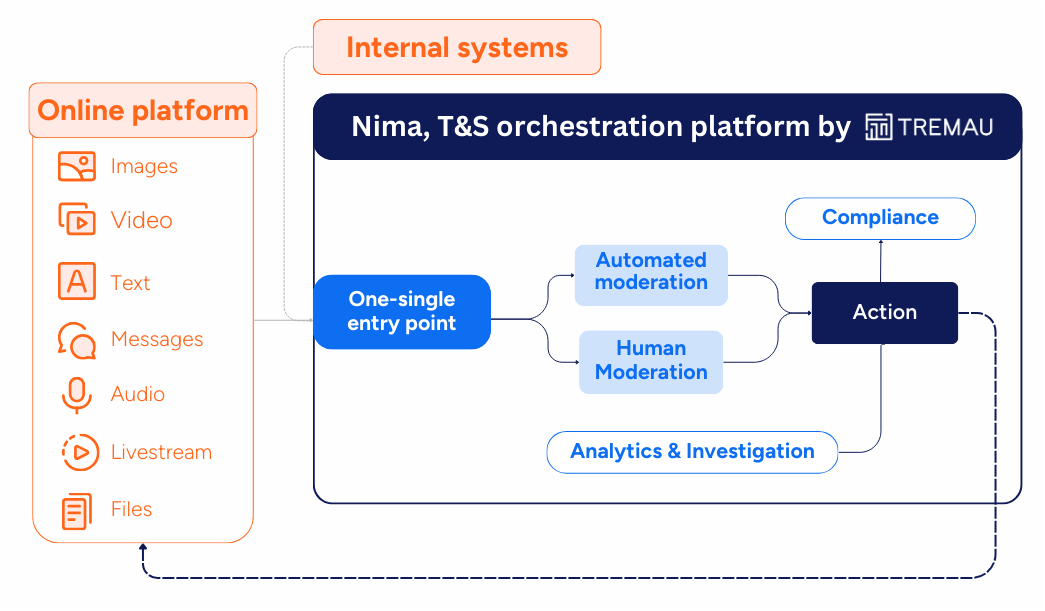
Scalable enforcement therefore depends on well-orchestrated pipelines: automation handles volume and prioritisation, while human judgement remains central to complex decisions and oversight. Without governance and the right orchestration layer, automation scales inconsistency as efficiently as it scales effectiveness.

Ensuring Quality and Consistency

With policies, intake, and high-quality pro-active detection in place, execution becomes the defining challenge: enforcement must be consistent, accurate, and defensible.

Strong quality assurance (QA) programs are critical. Effective QA reduces error rates, ensures consistent decision-making, and builds confidence in enforcement outcomes. Such programs include targeted training, regular reviews of prior decisions, calibration exercises, and structured feedback loops. Importantly both human and automated decisions should be covered as even the most advanced systems struggle with edge cases and emerging abuse.

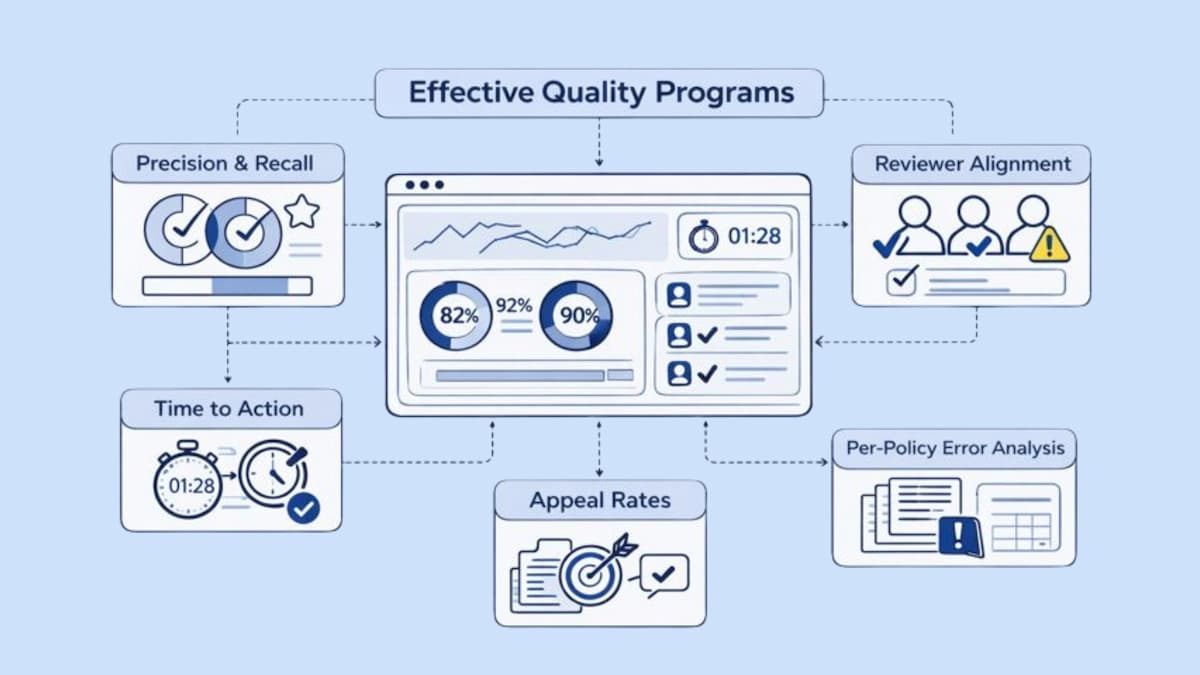
Quality programs are most effective when grounded in clear metrics. Examples of such metrics include: precision and recall, time to action, reviewer alignment, appeal rates, and per-policy error analysis. These indicators surface issues early, whether caused by policy ambiguity, training gaps, or tooling limitations.

Appeals data is particularly valuable. Systematic analysis of overturned decisions often reveals structural weaknesses — such as unclear definitions or outdated enforcement criteria. At scale, appeals become a feedback engine for continuous improvement, informing policy refinements, training updates, and workflow or tooling changes.

Transparency As a Trust Multiplier

No enforcement system builds trust without transparency.

Explaining enforcement decisions is not just a legal requirement in the EU, but it provides legitimacy to platforms and is essential for user retention. Users are more likely to accept outcomes they understand. Poor notifications can undermine even the strongest enforcement frameworks.

Effective notifications are timely, specific, and written in plain language. They explain which policy was applied, what action was taken, and how users can appeal. Done well, they reduce confusion, discourage repeat violations, and reinforce behavioural norms.

At a systemic level, transparency reporting demonstrates platform accountability. Publishing aggregate data on enforcement volumes and detection methods — broken down by policy categories — should be viewed as a trust-building practice, not a compliance burden. Transparency strengthens credibility with users, regulators, civil society, and partners.

A Path to Trust & Safety Maturity

There is no single model for Trust & Safety maturity. Strong enforcement systems are built incrementally, on foundations of policy, reporting, moderation, automation, and transparency — ideally unified through an orchestration layer.

Most teams start reactively, focused on immediate risk management. Over time, these systems can evolve into proactive, scalable operations that reduce harm earlier and enforce more consistently. Maturity is not about perfection; it is about sustained progress.

Platforms do not need to navigate this journey alone. The right partners can accelerate maturity, clarify operational trade-offs, and help teams scale enforcement without sacrificing fairness or trust.

👉To support teams in applying these principles in practice, we’ve created a structured checklist helping to assess the maturity of enforcement systems across key operational areas.

In the meantime, you can also explore:

Discover how Nima – our end-to-end T&S platform can support your workflows – from reporting and investigations to AI automation – enabling teams to work faster and more confidently. 

Check Tremau’s Advisory services – expert guidance on navigating Trust & Safety processes and regulatory compliance, building governance and policy frameworks and managing risk in fast-evolving digital environments.